
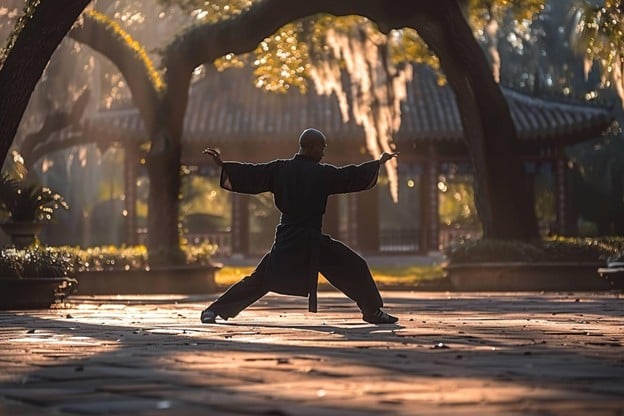
In an era defined by speed and instant results, many beginners entering kung fu training are often surprised by one core principle: progress is intentionally slow, repetitive, and deeply structured. Rather than constantly introducing new techniques, traditional Shaolin systems emphasize repeating foundational movements, sometimes for years. This approach is not accidental. It reflects a philosophy where mastery is built through time, discipline, and refinement rather than quick advancement.
Why Repetition Is Central to Kung Fu Training
At the heart of kung fu training lies the concept of Ji Ben Gong, or foundational skills. These include stances like Ma Bu (horse stance), Gong Bu (bow stance), and basic strikes and blocks. While they may appear simple, these movements form the structural base of all advanced techniques.
Repetition in kung fu training serves several purposes:
- Neuromuscular conditioning: Repeated movements train the body to respond instinctively
- Structural alignment: Proper posture ensures power generation and injury prevention
- Energy efficiency: Movements become precise, reducing unnecessary exertion
- Mental discipline: Focus is sharpened through consistent practice
Unlike modern fitness routines that prioritize variation, kung fu training relies on repetition to build internal consistency. Over time, what begins as a mechanical action evolves into fluid, controlled movement.
Time as a Teacher in Kung Fu Training
One of the most misunderstood aspects of kung fu training is its relationship with time. Progress is not measured in weeks or months but in years of consistent effort. This reflects the Shaolin belief that time itself is an essential training partner.
In practical terms, this means:
- Movements are practiced slowly before speed is introduced
- Forms (Taolu) are repeated to refine transitions and flow
- Power (Fa Jin) is developed gradually through correct mechanics
Research in motor learning, supported by institutions like the National Institutes of Health, shows that slow, repetitive practice enhances long-term skill retention and coordination. Kung fu training has embodied this principle for centuries, emphasizing depth over speed.
The Role of Slowness in Building Control
In many martial arts, speed is often seen as the ultimate goal. However, in traditional kung fu training, speed is a byproduct, not a starting point. Practitioners are taught to move slowly to develop control, balance, and awareness.
This deliberate pace allows students to:
- Understand weight distribution and center of gravity
- Coordinate breath with movement (Qi regulation)
- Refine transitions between stances and techniques
- Build internal strength rather than relying on momentum
By slowing down, practitioners develop a level of control that cannot be achieved through rushed practice. Over time, speed emerges naturally, supported by precision and stability.
From Repetition to Muscle Memory
One of the most visible outcomes of consistent kung fu training is the development of muscle memory. However, in Shaolin practice, this process goes beyond simple automation. It evolves into what practitioners often describe as embodied knowledge.
Organizations such as the International Wushu Federation emphasize that structured, repetitive practice is essential for developing precision, balance, and long-term technical mastery, principles that remain central to traditional kung fu training.
Through repetition:
- Movements become instinctive rather than conscious
- Reaction time improves under pressure
- Techniques can be executed with minimal mental effort
- The body and mind begin to operate in unison
This level of integration is what distinguishes true mastery from surface-level skill. It is not about memorizing techniques but about internalizing them through disciplined repetition.
Why Modern Training Approaches Often Fall Short
Many contemporary fitness and martial arts programs emphasize variety and rapid progression. While this can keep participants engaged, it often limits the depth of skill development.
Kung fu training takes a different approach:
- Consistency over novelty: Repeating the same movement refines technique
- Depth over speed: Mastery is prioritized over quick advancement
- Process over outcome: The journey itself is part of the training
This structured methodology ensures that practitioners develop a strong foundation, reducing the risk of injury and improving long-term performance.
The Psychological Discipline Behind Mastery
Beyond physical conditioning, kung fu training is deeply rooted in mental discipline. Repeating the same movements requires patience, focus, and resilience, qualities that extend beyond the training hall.
Research supported by the National Academy of Sports Medicine suggests that controlled, repetitive movement patterns significantly improve neuromuscular coordination and long-term skill retention, principles that have long been embedded in traditional kung fu training systems.
Practitioners often develop:
- Increased concentration and attention to detail
- Greater tolerance for slow progress
- A disciplined approach to long-term goals
- Emotional regulation through structured practice
These mental attributes are not separate from physical training; they are cultivated through the same process of repetition and time.
Building Mastery Through Structured Progression
Kung fu training is not random; it follows a carefully designed progression system. Beginners start with foundational stances and drills before advancing to forms, sparring, and advanced techniques.
This progression ensures:
- Each skill builds upon a solid foundation
- Weaknesses are addressed early
- Practitioners develop both external technique and internal awareness
- Mastery is achieved through accumulation rather than shortcuts
By respecting this structure, students develop a deeper understanding of movement, power, and control.
Repetition as a Path to Mastery
What may appear repetitive or slow to an outsider is, in reality, a highly refined method for building lasting skill. Kung fu training uses repetition not as a limitation, but as a pathway to mastery. Each movement, repeated with intention, brings practitioners closer to precision, efficiency, and control.
Over time, the body adapts, the mind sharpens, and the connection between the two strengthens. This is the essence of kung fu, not just learning techniques, but cultivating a disciplined, integrated approach to movement and self-development.
Looking Ahead: Redefining Progress in Martial Arts
In a world that often values speed and immediate results, kung fu training offers a different perspective, one where mastery is earned through patience, repetition, and time. This approach may seem demanding, but it provides a depth of skill and understanding that cannot be achieved through shortcuts.
For those willing to embrace the process, kung fu training becomes more than a physical practice. It becomes a system for developing discipline, resilience, and long-term growth, both inside and outside the training hall.
